
When a buyer asks an AI system for advice, three different things can happen to your brand. Your page can support the answer as a citation. Your company can appear as a visible mention. Or the answer can place you inside a recommendation or shortlist. Those outcomes are related, but they are not interchangeable—and reporting them as one metric creates false confidence.
The three layers of AI visibility
A citation shows that a model or search layer selected a page as useful evidence. The answer may use a statistic, definition, checklist, or explanation from that page while the brand remains invisible in the prose. A mention means the brand name is present, but the context may be neutral: a directory entry, an example, or one option among many. A recommendation is stronger. It connects a named company to a buyer’s specific decision criteria and often explains why it fits.
Each layer answers a different business question. Citations show information authority. Mentions show entity recognition. Recommendations show commercial relevance. A healthy program tracks all three instead of presenting a large citation count as proof that demand is already moving.
Why a cited page may not produce a named brand
Informational pages are often designed to answer a narrow question, not to establish a recognizable provider. If the page contains a clear explanation but weak authorship, inconsistent company details, no product or service context, and no corroboration elsewhere, an AI system can extract the explanation without confidently connecting it to the brand.
Intent also matters. A prompt such as “What is GEO?” calls for an explanation. A prompt such as “Which GEO partner is suitable for a B2B SaaS company entering DACH?” calls for entities, comparison criteria, evidence, and fit. Publishing only definitions may increase source eligibility while leaving the commercial decision space empty.
Measure the answer, not only the source list
Build a repeatable prompt set around actual buyer decisions. For every prompt, record the answer date, model or surface, cited URLs, named brands, position and language. Then classify the outcome: cited only, mentioned neutrally, recommended, or absent. Add sentiment and factual accuracy when the brand appears.
Evidence in context
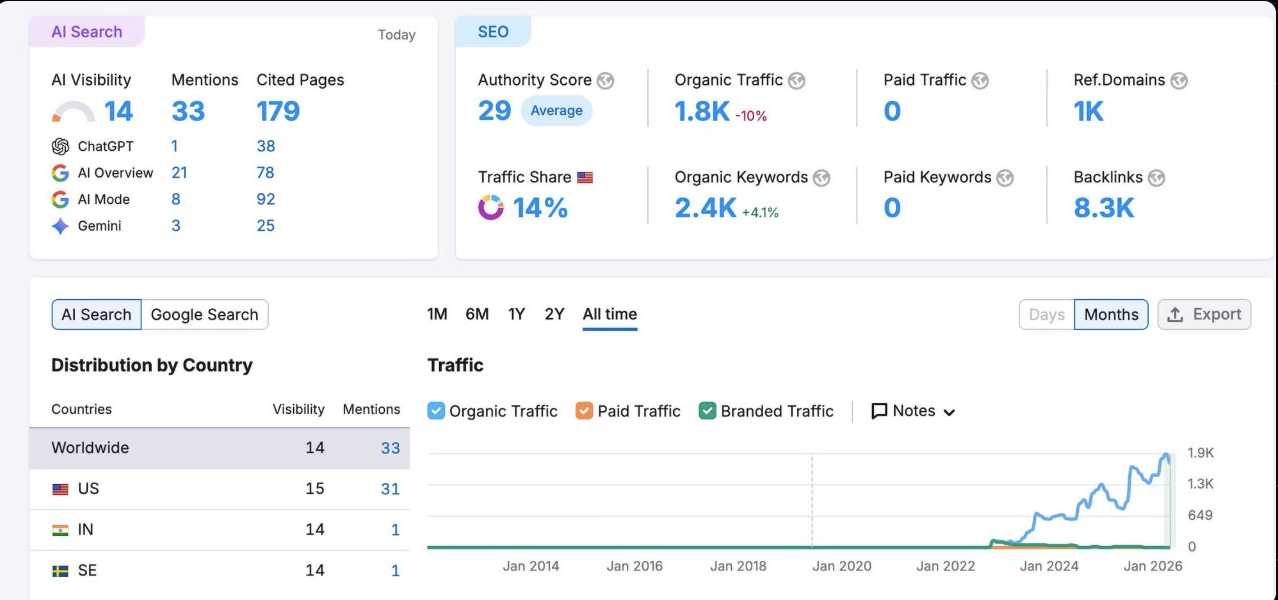
One anonymized early-stage B2B SaaS snapshot on our Results page shows 33 AI mentions and 179 cited pages. The gap is the lesson: cited-page volume and brand visibility are separate indicators. The snapshot supports observed visibility, not a claim that a single intervention caused every mention.
Review this dataset by prompt cluster, not as one blended score. A provider can be strong in educational prompts and absent from comparisons. That distinction tells the team what to build next.
Build from source authority to decision relevance
Start with pages that deserve to be used: clear definitions, original operating detail, named authorship, current facts, and accessible technical structure. Then strengthen entity signals across the site: consistent company descriptions, expert profiles, service or product relationships, schema, and internal links.
Commercial visibility needs another layer. Create honest comparison pages, alternative pages, use-case pages, vertical pages, implementation guidance, and proof modules that explain constraints as well as strengths. Support them with credible external signals—editorial references, reviews, expert commentary, and accurate directory profiles. The goal is not to manufacture consensus; it is to make a defensible choice easy to verify.
A practical weekly review
Ask these five questions
- Which high-value prompts cited us but did not name us?
- Where were we mentioned without a reason to choose us?
- Which competitors were recommended, and what evidence supported them?
- Is the missing evidence on our site, outside our site, or both?
- What single asset or authority action would close the most valuable gap?
That review turns AI visibility from a vanity dashboard into a production queue. Citations remain valuable, but they become the start of diagnosis—not the finish line. The commercial question stays visible throughout.